Perspectivas
Fuel is aviation’s biggest cost. It’s also its most overlooked quick win.

Suraj Singh
Director de Marketing, i6 Group

Fuel is aviation’s single largest operational cost, and in 2026 that pressure is heavier than ever. IATA’s mid-year outlook put the industry’s fuel bill at around $350 billion, up from $252 billion in 2025. That's roughly 31% of airlines' total operating costs.
Airlines aren’t burning more fuel. IATA expects total consumption to stay flat at 104 billion gallons, but jet fuel is forecast to average $152 a barrel this year, up almost 70% on 2025. Middle East volatility that peaked in spring upended the energy market, squeezing margins across the board.
At October’s World Aviation Festival in Lisbon, AI innovation dominated the headlines. Yet most of the conversations we held steered back to the more immediate question: where can cost be cut from the operation today?
For a growing number of airlines, the answer is on the ramp.
Since the industry committed to net zero in 2021, efficiency and sustainability have felt like separate tracks. SAF, new aircraft and carbon offsets are expected to deliver 97% of the cut according to IATA, so that’s where sustainability budgets have naturally been focused. Operational efficiency, worth roughly 3%, has sat under cost control.
In refueling, the two tracks merge. Burning less fuel (and loading exactly what fuel is needed) cuts cost and carbon simultaneously.
Most refueling waste builds up quietly from small gaps between the flight deck, ops and the into-plane team. Paper dockets travel slowly, discrepancies between the fuel ordered and the fuel uplifted go unnoticed, and every extra kilogram costs fuel to carry: roughly 3% of the excess is burned per block hour.
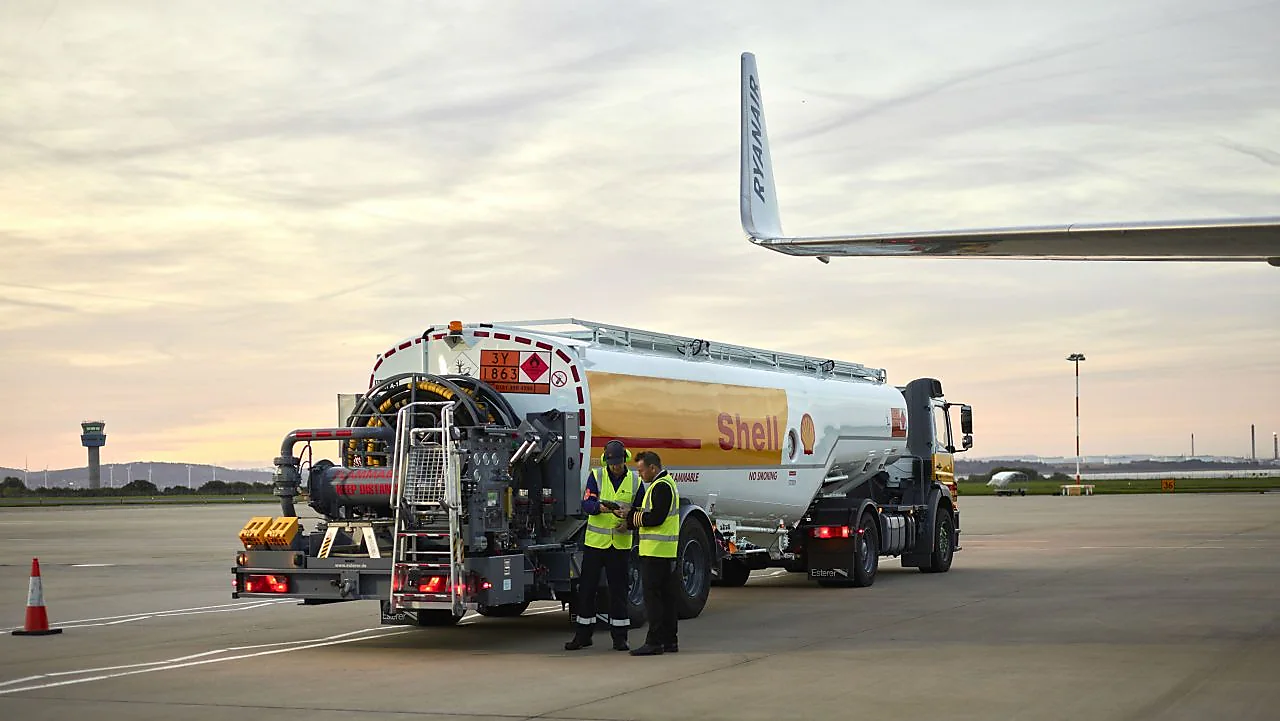
Ryanair runs around 3,600 flights a day, targeting a 25-minute turn on each. At our fireside chat on the airline’s turnaround strategy, Stephen Fitzgerald, Ryanair’s Director of Sustainability and Finance, described the paper fuel docket as “the one analogue piece of our turnaround.” Now that Ryanair handles around 30,000 flights a month through real-time digital fuel confirmation, they’re saving roughly 5-10 minutes a turn. That matters more than it sounds: “if you suffer delay early enough in the day, it gets exacerbated throughout the rest of the day.”
The industry’s flagship decarbonization levers are still years away from scale:
Fleet renewal is bottlenecked: Global commercial aircraft backlogs surpassed 17,000 orders this summer, representing a 12-plus-year production runway according to ADS Group.
Next-gen propulsion is slipping: Airbus has pushed back its 2035 target for a commercial hydrogen aircraft with no firm replacement date.
SAF supply remains tight: SAF is forecast to make up just 0.8% of global jet fuel in 2026, a fraction of the 2% the UK and EU now mandate.
Meanwhile, avoidable fuel is being burned on the apron every day. At London Heathrow alone, British Airways has cut around 6,000 tonnes of CO2 by digitizing refueling – saving up to 201 kg of CO2 per flight. Similarly, into-plane operator Menzies Aviation has cut operational delays by 47% and improved fuel efficiency by 35% on average across its digitized UK operations. Gains like these compound rapidly across a fleet’s annual departures.
Fuel doesn’t reach an aircraft on its own. It moves through the into-plane teams who deliver it, and the biggest gains happen when the airline and its fueling partner operate from the same live data. Once both sides are looking at one real-time record instead of relying on paper dockets, the manual errors, disputes and delays between them start to disappear.
That disconnect between the airline and the ramp is one of the largest and least-addressed sources of fuel waste, and where the fastest cost-and-carbon win is hiding.
In fuel operations, cutting cost and cutting carbon are the same job. With fuel prices volatile and reporting requirements tightening, the airlines and fueling partners that treat them as one problem will hold the advantage.
What is refueling costing your operation? Talk to our team about where digital fuel confirmation could save fuel, time and carbon across your network.